


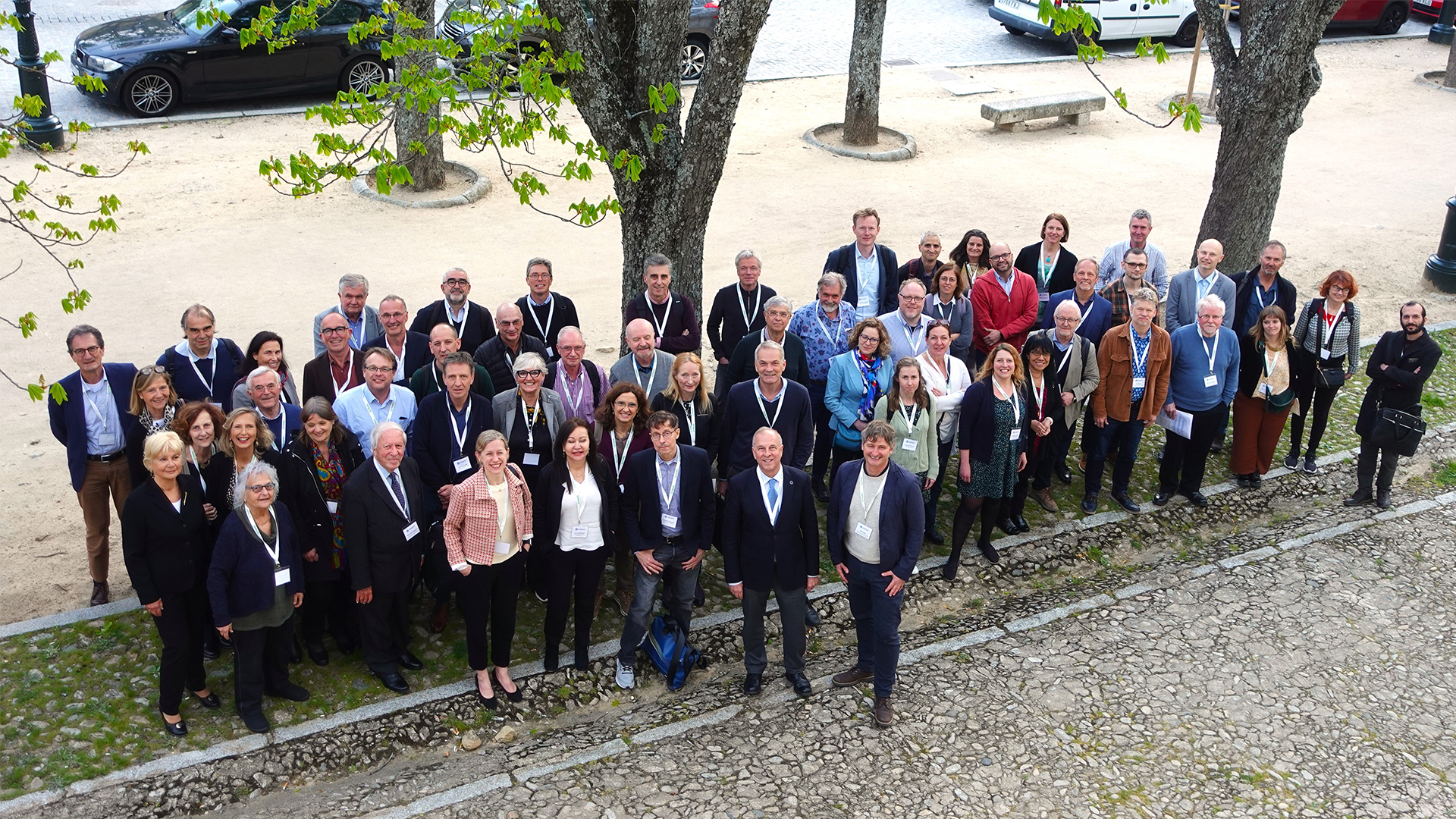
The European Academy of Microbiology (EAM) held a meeting of its fellows from 5 to 6 April, at Parador de La Granja, near Madrid, Spain. The event brought together 56 fellows from 20 countries for 2 days of networking, updates, and the sharing of research. Esteemed fellows recently admitted to the Academy presented their latest work showcasing the impacts they are having on science and society as fellows.
The Academy also heard presentations from three rising stars in microbiology:
- Hedvig Tamman, University of Tartu (Estonia)
- Mirko Cortese, The Telethon Institute of Genetics and Medicine (TIGEM) (Italy)
- Katharina Höfer, Max Planck Institute for Terrestrial Microbiology (Germany)
Attendees took the opportunity to share the success and discuss the direction of microLife, the Federation of European Microbiological Societies (FEMS) open access journal supported by the fellows of the EAM.
Jörg Vogel, President of EAM, and Antonio Ventosa, the newly appointed President of FEMS, met with Elise Kuurstra, the Executive Director of FEMS, to facilitate discussion on how the EAM can flourish and provide further value and impact. Since being set up by FEMS in 2009, the EAM is now crucial for advancing the field of microbiology in Europe.
The meeting also provided an occasion for Prof. Ken Timmis, who will take over the role of EAM President in 2025, to outline his vision for the important role the EAM could play in making a difference to microbiology in Europe, society, and the world.
Acknowledgements are extended to all fellows who attended the meeting, with special thanks to all involved in organizing and overseeing the proceedings. The event underscored a collective commitment to strengthen the voice and impact of microbiology across Europe.
To get to know some of our new fellows, learn more in our Microbes and Us podcast episode with Aude Bernheim or our video interview with Maja Rupnik. The new fellows elected to the European Academy of Microbiology in 2023 are:
- Shoshy Altuvia, The Hebrew University of Jerusalem (Israel)
- Irini Angelidaki, Technical University of Denmark (Denmark)
- Petr Baldrian, The Czech Academy of Sciences (Czech Republic)
- Aude Bernheim, Pasteur Institute (France)
- Oliver Billker, Umeå University (Sweden)
- Harald Brüssow, Catholic University of Leuven (Belgium)
- Jean-François Collet, – Université Catholique de Louvain (Belgium)
- Isabel Delany, GSK (Italy)
- Francisco Garcia del Portillo, Centro Nacional de Biotecnología – CSIC (Spain)
- Lone Gram, Technical University of Denmark (Denmark)
- Angela Ivask, University of Tartu (Estonia)
- Anna Karnkowska, University of Warsaw (Poland)
- Boris Klempa, Slovak Academy of Sciences (Slovakia)
- Mart Krupovic, Institut Pasteur (France)
- Rob Lavigne, KU Leuven (Belgium)
- Marc Lecuit, Institut Pasteur (France)
- Paul O’Toole, University College Cork (Ireland)
- Vladimir Pelicic, CNRS Aix-Marseille University (France)
- Andreas Peschelm, University of Tübingen (Germany)
- Pavel Plevka, Masaryk University (Czech Republic)
- Thomas Rudel, University of Würzburg (Germany)
- Maja Rupnik, National Laboratory of Health, Environment and Food (Germany)
- George Salmond, University of Cambridge (UK)
- Barbara Stecher, LMU Munich (Germany)
- Noam Stern-Ginossar, The Weizmann Institute of Science (Israel)
- Jan-Willem Veening, University of Lausanne (Switzerland)
About the EAM and microLife
 microLife is a gold Open Access journal associated with the European Academy of Microbiology (EAM) and supported by the Federation of European Microbiological Societies (FEMS) with our not-for-profit publisher Oxford University Press (OUP).
You can publish full-length research articles, Short Reviews, and commentaries reporting research of the highest standard, novelty, and significance in the field of microbiology and related disciplines. All microbes are covered including bacteria, archaea, fungi, protists, parasites, and viruses.
Deprecated: File Theme without comments.php is deprecated since version 3.0.0 with no alternative available. Please include a comments.php template in your theme. in /www/femsmicrobiologyorg_934/public/wp-includes/functions.php on line 6121