

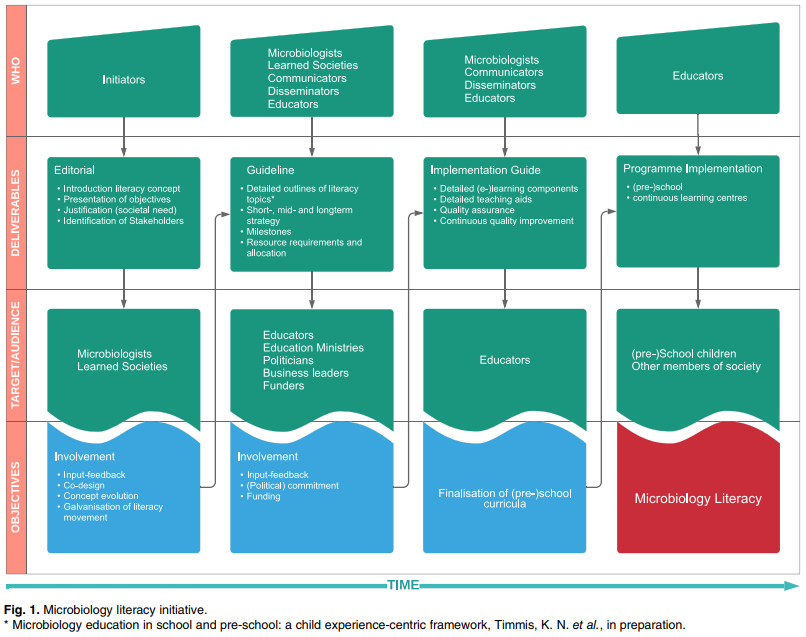
Microbes and their activities have pervasive, remarkably profound and generally positive effects on the functioning, and thus health and well-being, of human beings, the whole of the biological world, and indeed the entire surface of the planet and its atmosphere. This necessitates their due consideration in decisions that are taken by individuals and families in everyday life, as well as by individuals and responsible bodies at all levels and stages of community, national and international planetary health assessment, planning, and the formulation of pertinent policies.
However, knowledge of relevant microbial activities, how they impact our lives, and how they may be harnessed for the benefit of humankind – microbiology literacy – is lacking in the general population, and in the subsets thereof that constitute the decision makers. We contend that microbiology literacy in society is indispensable for informed personal decisions, as well as for policy development in government and business, and for knowledgeable input of societal stakeholders in such policymaking. An understanding of key microbial activities is as essential for transitioning from childhood to adulthood as some subjects currently taught at school, and must therefore be acquired during general education. Microbiology literacy needs to become part of the world citizen job description.
Given the current exceptional level of excitement in microbiology, and the impact of its breathless pace of progress on everyday lives, microbiology can become one of the most fascinating and inspiring topics in school curricula, both for teachers to teach and for pupils to learn!
Read the full Editorial by Timmis et al. here!
We may fret about how little we know and can trust our human acquaintances, while knowing essentially nothing about our most intimate and influential friends. Attainment of an ability to maximize our personal well-being will require that we comprehend
•what our microbial partners are doing,
•what impact their activities have on us,
•how our microbial partners and their activities are affected by what we do, and
•how we can improve our partnerships for mutual benefit”
Timmis et al. (2019), Environmental Microbiology 21(5), 1513–1528, doi:10.1111/1462-2920.14611
- For translations into Spanish, Hindi, Korean and French (translations into more languages to come!) click here.
- For a summary of the editorial in layman English, click here.
- For a summary written for kids and young adults, click here.
Deprecated: File Theme without comments.php is deprecated since version 3.0.0 with no alternative available. Please include a comments.php template in your theme. in /www/femsmicrobiologyorg_934/public/wp-includes/functions.php on line 6121